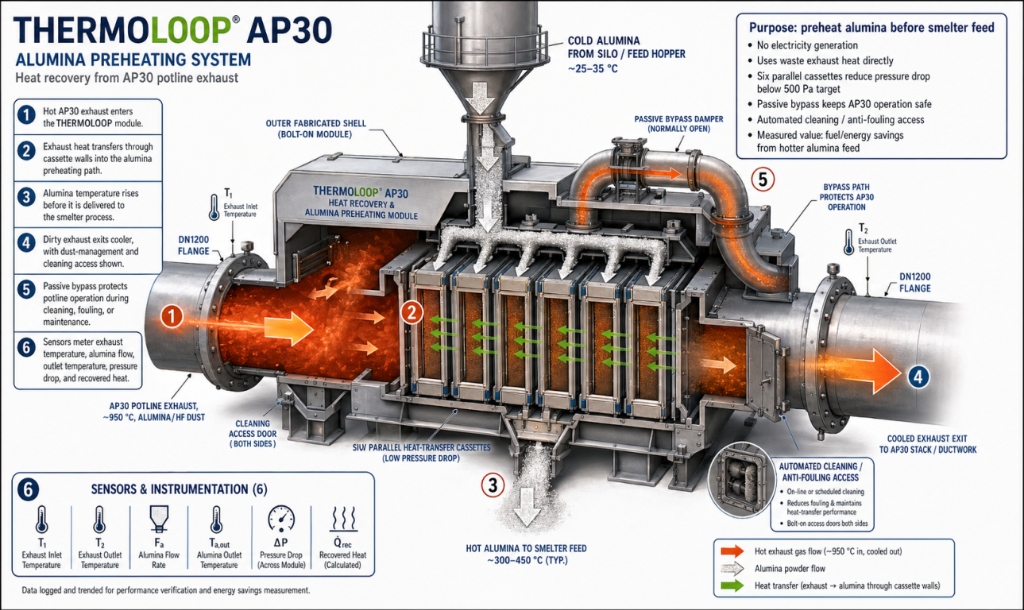
The THERMOLOOP Mandate: To partner with Metlen on a zero-CAPEX, performance-based pilot on a single potline—proving an irrefutable 80+ kWh/ton in energy savings. We take the hardware risk, share the upside, and build a bankable, scalable blueprint for full deployment.
Pitch Position
THERMOLOOP integrates seamlessly into the AP30 potline to directly preheat the granular alumina feed using captured exhaust heat. By avoiding complex turbomachinery, Metlen significantly reduces capital costs while achieving massive, verified energy savings with zero operational risk.
| Metlen aluminium production basis | 190,000 t/y |
| Annual electricity consumption | 0 TWh/y |
| Net energy offset per tonne | 0.0 MWh/t Al |
| Plant demand offset | 0% |
| Thermal recovery | 11.1% of total sensible waste heat |
| Design extraction window | ~102% of 950->850 C target |
| Pressure-drop correction | 6 parallel cassettes |
Connect with the Founders
The engineering and business team driving the AP30 preheating revolution.
Core Assumptions
Market Inputs
CAPEX Inputs
Investor View
| Metric | Value |
|---|
Sensitivity
- Module count: Number of heat recovery cassettes.
- Al production: Annual smelter output; defines available exhaust heat.
- Specific electricity: Baseline energy needed per tonne of Al.
- Net output: Energy offset generated per cassette.
- Capacity factor: Expected annual uptime percentage.
- Project life: Operational lifespan in years.
- Discount rate: Rate to calculate present value of future returns.
- Electricity value: Grid electricity price avoided via offset.
- Carbon price: Value of avoided EU ETS/CBAM emissions.
- Emissions factor: Tonnes of CO2 per MWh of grid power.
- Annual O&M: Maintenance cost as a % of CAPEX.
- WHR module cost: Installed hardware cost per cassette.
- Shared power block: Fixed cost for centralized infrastructure.
- Engineering + contingency: Buffer for unexpected costs.
- Material escalation: Expected inflation for hardware materials.
- Electricity escalation: Annual inflation for electricity prices.
Energy-Sharing Plan
Equity Terms & Investor Return
Who Constructs It?
| Work package | Responsible party |
|---|---|
| System integrator and performance owner | THERMOLOOP |
| Hot-side core cassettes | Certified superalloy AM / hybrid manufacturing partner under THERMOLOOP QA |
| Outer shell, flanges, trunnions, duct adapters | Pressure-vessel / heavy-fabrication shop using cost-reduced alloy strategy |
| sCO2 turbo-compressor, recuperator, cooler | Packaged turbomachinery and heat-exchanger OEMs |
| Site installation and tie-in | Metlen-approved EPC contractor during planned outage window |
| Operation, cleaning, monitoring | THERMOLOOP under monthly service + energy-share contract |
Cost After Manufacturing Cuts
| Item | Cost |
|---|
Profit Split
| Metric | THERMOLOOP | Metlen |
|---|
Live Data Desk
Use this when you have Wi-Fi and credentials. If the API is blocked by CORS or missing a token, the manual values remain active.
Live source: ENTSO-E Transparency Platform for Greece day-ahead power price. Carbon source: European Commission CBAM certificate price page.
No live fetch attempted yet.
Market Values In Use
| Input | Current | Source mode |
|---|---|---|
| Electricity value | €0/MWh | Manual default |
| Carbon price | €0/t | Manual default |
| Grid emissions factor | 0 t/MWh | Editable assumption |
| Annual plant electricity consumption | 0 MWh | Production x specific consumption |
| Annual generated energy | 0 MWh | Calculated |
| Net electricity after THERMOLOOP | 0 MWh | Consumption minus generated offset |
| Aluminium production basis | 190,000 t/y | Metlen plant scale assumption |
| Production scaling factor | 1.00x | Relative to 190,000 t/y design basis |
| Energy offset intensity | 0 MWh/t Al | Calculated |
| Plant demand offset | 0% | Generated MWh / annual consumption |
Scenario Buttons
FEA-Style CFD Flow Simulation
This embedded visual is a reduced-order finite-element-style CFD screening view. It shows pressure contours, velocity vectors, particle traces, and the pressure-drop correction from six parallel cassettes. Open it full screen here: flow simulation.
How It Works
Thermal Balance
| Quantity | Value | Pitch use |
|---|
Deliverables Already Generated
Macro shell STL for fit-up, micro-core STL for lattice proof, sCO2 PFD, stream table, and equipment list.
| Asset | Purpose |
|---|---|
| Macro shell STL | Overall 1600 x 1400 x 1400 mm form factor, DN1200 interface, trunnions, bypass shell. |
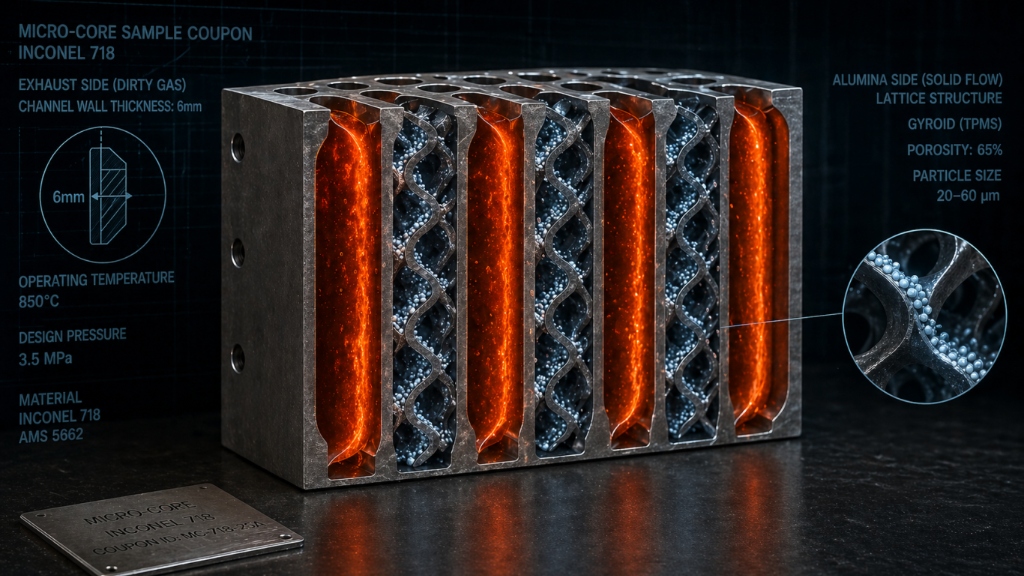
| Micro-core STL | 0.4 mm high-fidelity 250 mm coupon showing guide-vane to gyroid transition. |
| sCO2 skid STL | Pitch-scale layout for compressor, recuperator, turbo-generator, cooler, inventory vessel, and piping. |
Mechanical Assembly
| Interface | Function |
|---|---|
| DN1200 PN16 flanges | Connect AP30 exhaust duct inlet/outlet. |
| Bellows-style flexure zones | Absorb thermal growth so existing ducting is not overstressed. |
| sCO2 nozzles | Carry high-pressure CO2 supply and hot return to the skid. |
| Passive bypass | Maintains smelter continuity during fouling, startup, or skid trip. |
| Lifting trunnions | Crane installation and maintenance handling. |
| Shielded sensor pockets | Protect RTDs and pressure transducers from dust, heat, and EMI. |
Construction Phasing
| Phase | Decision gate | Budget |
|---|
Risk Register
| Risk | Mitigation in pitch design |
|---|---|
| Alumina dust clogging | 40 mm channel clearance, bypass, vortex air-pulse cleaning. |
| HF/fluoride corrosion | Inconel/Haynes material metadata and low-stagnation smooth geometry. |
| Alumina handling wear | Gravity-fed enclosed conveying and abrasion-resistant rotary valves. |
| Potline downtime | Passive exhaust bypass and bolt-on flange replacement strategy. |
| CAPEX intensity | Serial module manufacturing and completely avoiding complex turbomachinery. |
Data Sources And Traceability
- Ember European electricity prices and costs: explains European wholesale price and carbon-cost tracking, with electricity price methodology based on ENTSO-E and other market sources.
- ENTSO-E API note via openHAB binding: confirms day-ahead price access requires an ENTSO-E Transparency Platform security token.
- European Commission CBAM certificate price: official Q1 2026 CBAM price is published as €75.36/tCO2e and 2026 uses quarterly prices.
- Metlen Aluminium of Greece R&D: lists energy recovery and CO2OLHEAT among relevant R&D activity.
- CO2OLHEAT project overview: sCO2 waste-heat-to-power demonstration context and replication sectors.
Room-Safe Defaults
The app defaults are deliberately conservative and editable. They are meant to support negotiation and sensitivity discussion, not replace a bankable feasibility study.
| Electricity value | €110/MWh |
| Carbon value | €75.36/tCO2 |
| Scale-out | 28 modules |
| Aluminium production basis | 190,000 t/y |
| Specific electricity consumption | 14.0 MWh/t Al |
| Net power | 539.8 kWe/module |
| Construction sale price | €30M nominal |
| THERMOLOOP share | 30% of verified value |